
Expanding genotype-phenotype correlations in FOXG1 syndrome: results from a patient registry
Authors: Elise Brimble, Kathryn G Reyes, Kopika Kuhathaas, Orrin Devinsky, Maura R Z Ruzhnikov, Xilma R Ortiz-Gonzalez, Ingrid Scheffer, Nadia Bahi-Buisson, Heather Olson; FOXG1 Research Foundation
Journal: Orphanet Journal of Rare Diseases
Date: June 21, 2023
Background: We refine the clinical spectrum of FOXG1 syndrome and expand genotype-phenotype correlations through evaluation of 122 individuals enrolled in an international patient registry.
Methods: The FOXG1 syndrome online patient registry allows for remote collection of caregiver-reported outcomes. Inclusion required documentation of a (likely) pathogenic variant in FOXG1. Caregivers were administered a questionnaire to evaluate clinical severity of core features of FOXG1 syndrome. Genotype-phenotype correlations were determined using nonparametric analyses.
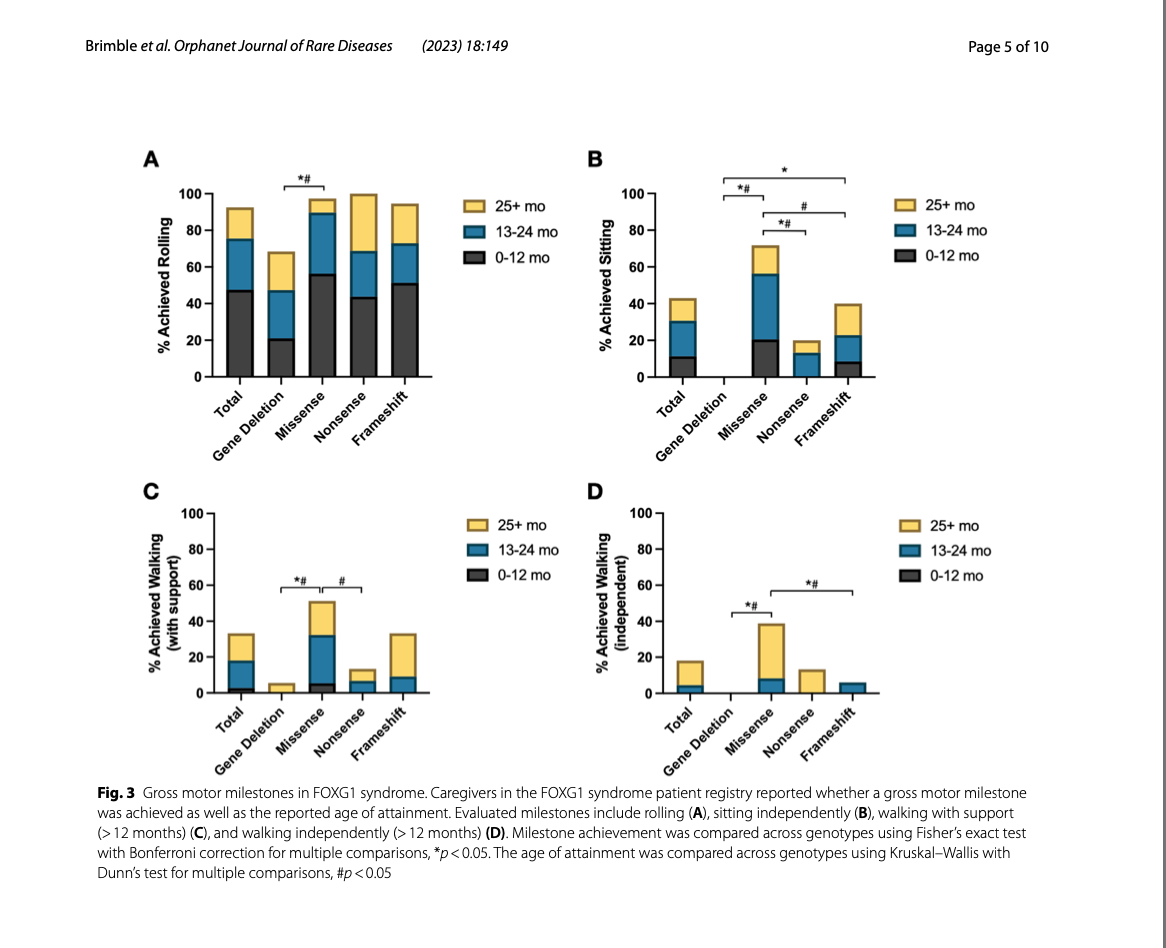
Results: We studied 122 registry participants with FOXG1 syndrome, aged < 12 months to 24 years. Caregivers described delayed or absent developmental milestone attainment, seizures (61%), and movement disorders (58%). Participants harbouring a missense variant had a milder phenotype. Compared to individuals with gene deletions (0%) or nonsense variants (20%), missense variants were associated with more frequent attainment of sitting (73%). Further, individuals with missense variants (41%) achieved independent walking more frequently than those with gene deletions (0%) or frameshift variants (6%). Presence of epilepsy also varied by genotype and was significantly more common in those with gene deletions (81%) compared to missense variants (47%). Individuals with gene deletions were more likely to have higher seizure burden than other genotypes with 53% reporting daily seizures, even at best control. We also observed that truncations preserving the forkhead DNA binding domain were associated with better developmental outcomes.
Conclusion: We refine the phenotypic spectrum of neurodevelopmental features associated with FOXG1 syndrome. We strengthen genotype-driven outcomes, where missense variants are associated with a milder clinical course.
FOXG1 Syndrome Patient Registry Publication in Orphanet Journal of Rare Diseases Author: Elli Brimble, FOXG1 Research Foundation Clinical Director
Fig. 3 Gross motor milestones in FOXG1 syndrome. Caregivers in the FOXG1 syndrome patient registry reported whether a gross motor milestone was achieved as well as the reported age of attainment. Evaluated milestones include rolling (A), sitting independently (B), walking with support (> 12 months) (C), and walking independently (> 12 months) (D). Milestone achievement was compared across genotypes using Fisher’s exact test with Bonferroni correction for multiple comparisons, *p < 0.05. The age of attainment was compared across genotypes using Kruskal–Wallis with Dunn’s test for multiple comparisons, #p < 0.05

FOXG1 Syndrome Patient Registry Publication in Orphanet Journal of Rare Diseases Author: Elli Brimble, FOXG1 Research Foundation Clinical Director
Fig. 2 Spectrum of pathogenic variants reported in the FOXG1 syndrome patient registry. The distribution of reported pathogenic or likely pathogenic FOXG1 missense, frameshift, and nonsense variants are depicted (A). The majority of missense variants cluster in the conserved forkhead DNA binding domain, whereas frameshift and nonsense variants are dispersed throughout the coding sequence. Specific protein domains or characteristics have been outlined, including: a poly‐histidine tract (pHis, amino acids 47–57), the forkhead DNA binding domain (amino acids 181–275), the Groucho‐binding domain (GBD, amino acids 307–317), and a JARID‐1B‐binding domain (JBD, amino acids 383–406). Frameshift = ▽, recurrent frameshift = ▽, nonsense = ▼, recurrent nonsense = ▼, missense = ▲, recurrent missense = ▲. The frequency of unique genotypes across the 122 participants are shown in a pie chart (B)