
FOXG1 Research Foundation Awarded $4.9M CIRM Grant to Advance Gene Therapy
An independent panel of scientists, clinicians, and patient advocates rated FRF-001 in the top tier — "exceptional merit and warrants funding."
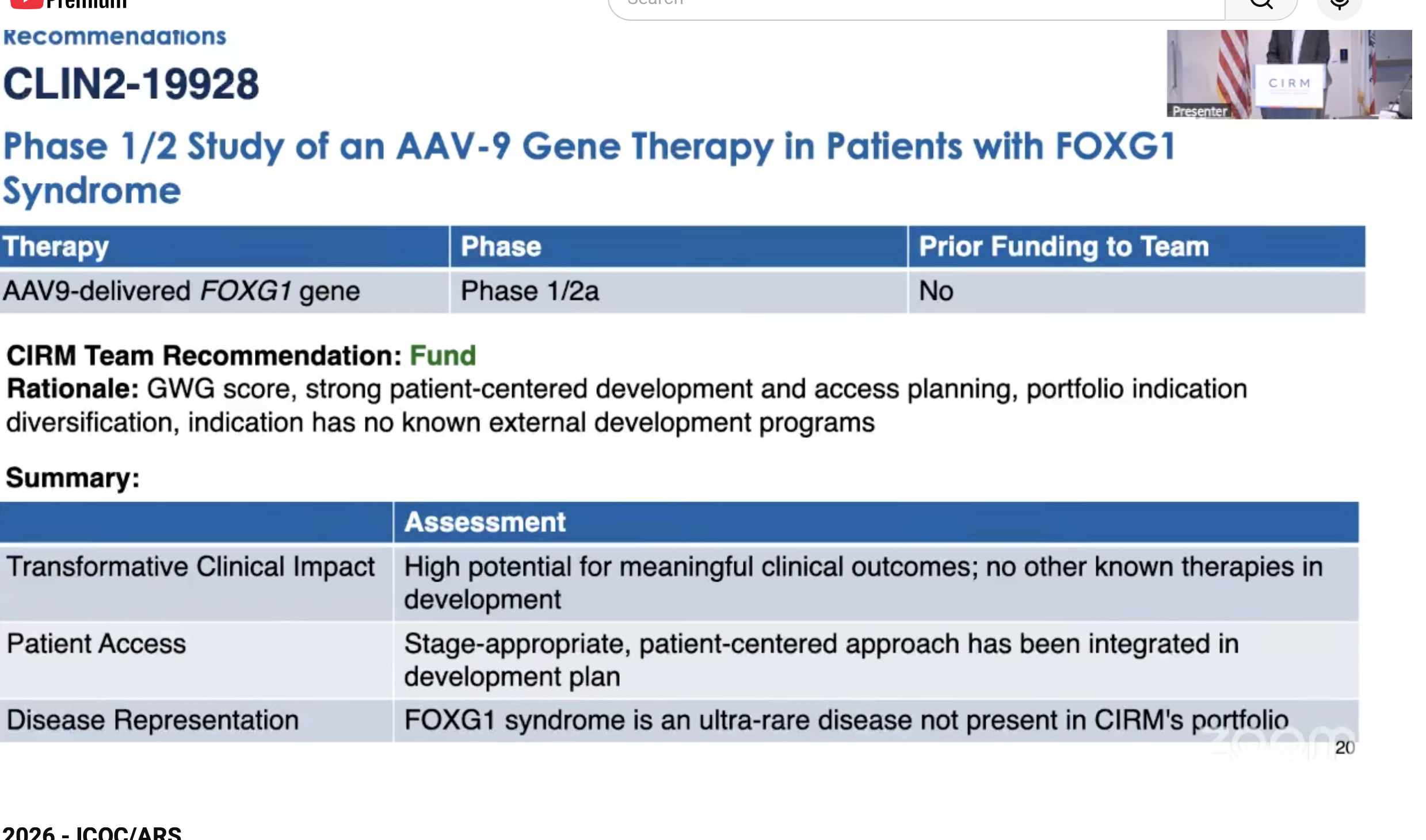
CIRM's Application Review Subcommittee recommends FRF-001 for funding, June 25, 2026.
California — June 25, 2026 — The FOXG1 Research Foundation (FRF) has been awarded a $4,928,664 grant from the California Institute for Regenerative Medicine (CIRM) to advance FRF-001, the Foundation's AAV9 gene therapy, through its Phase 1/2 patient clinical trial. The award — the full amount requested — was announced during CIRM's governing board meeting on June 25, 2026.
CIRM is one of the most competitive funding sources in regenerative medicine. Every application is evaluated by an independent panel of up to 15 scientists, clinicians, manufacturing and regulatory experts, and patient advocates with no connection to the applicant. Reviewers assess the evidence alone — the strength of the science, the credibility of the clinical plan, and the readiness of the team.
After reviewing FRF's application, the panel placed FRF-001 in the top tier, classifying the program as having "exceptional merit and warrants funding." For a foundation built and led by parents, the recognition behind the funding is just as meaningful as the funding itself.
In the reviewers' words
Across the review, the panel returned again and again to two themes: the strength of the science, and the community that built the program.
Strong science — reviewers cited the program's "very strong preclinical data."
An exceptional team — they described a "strong and committed team" that did "an exceptional job incorporating the patient voice into every step."
Powered by our families — they called the Foundation's caregiver involvement "impressive" and its Patient Advisory Group "exemplary."
A true first — they noted a "huge unmet need" with "no known competing products."
Ready to begin — they found the trial well-designed for safety, with an "impressive number of ready-to-go participants."
The reviewers also asked the rigorous questions that every first-in-human gene therapy program must answer. But their overall conclusion was unmistakable: the unmet need is enormous, the science is compelling, the clinical plan is credible, the team is strong, and the community behind it is exceptional.
Why this matters
FOXG1 syndrome is an ultra-rare genetic neurological disorder with no approved disease-modifying treatments. For the families living with it, the current standard of care is supportive — managing symptoms, never the underlying cause. FRF-001 represents a different path: a gene therapy designed to address the genetic root of the condition.
The recognition went beyond the review panel. CIRM's own team recommended FRF-001 for funding, citing its strong patient-centered development and access planning and an indication with 'no known external development programs.' They rated its potential as 'high potential for meaningful clinical outcomes' and noted that FOXG1 syndrome is an ultra-rare disease not previously represented in CIRM's portfolio. For a condition that until recently had no drug program at all, that assessment marks how far this community has come.
What makes this milestone historic is not only the science, but what it represents for a community that willed this program into existence. No one understands that better than the parents who have carried it from the beginning.
"The FOXG1 community didn't inherit a drug development program. Families built it. Parents created the registry, participated in the natural history study, and shared their experiences so researchers could understand which outcomes would truly matter in their children's lives. Many of those parents were told, just as we were, that nothing could be done. They refused to accept that answer. For Crosby and every individual living with FOXG1 syndrome, this award represents far more than funding — it is proof that what began as a group of determined families has become something much larger." — Ryan Phillips, Chief Financial Officer, FOXG1 Research Foundation, and father to Crosby
With gratitude to our clinical team
This recognition reflects the countless hours and unwavering dedication of the FRF-001 clinical team: Dr. Gai Ayalon, Elli Brimble, Dr. Brandon Michael Henry, and Mallory Lauth. To them, and to every family at the heart of this work — thank you.
Thank you to all the parents, families, partners, and supporters whose belief in this mission brought us here.
About FOXG1 syndrome
FOXG1 syndrome is a rare neurological disorder caused by mutations in the FOXG1 gene, resulting in profound intellectual disability, limited or no speech, seizures, and significant motor impairments. There are currently no approved disease-modifying treatments. [Optional: insert FRF's standard prevalence figure here.]
About the FOXG1 Research Foundation
Founded in 2017, the FOXG1 Research Foundation is a parent-led rare disease foundation dedicated to advancing a gene therapy through patient clinical trials and improving the lives of every patient and everyone impacted by FOXG1 syndrome. FRF has pioneered a new model for rare disease drug development — cutting both time and cost by a fraction — creating a blueprint for countless rare disease communities. Learn more at foxg1research.org.
About CIRM
The California Institute for Regenerative Medicine (CIRM) is California's state agency for regenerative medicine, created by voter initiative to accelerate stem cell and gene therapy treatments to patients with unmet medical needs. CIRM funding is restricted to California-based research and program expenses.
Media contact
press@foxg1research.org