
FOXG1 Syndrome Earns Unique ICD-10 Code: QA00.151
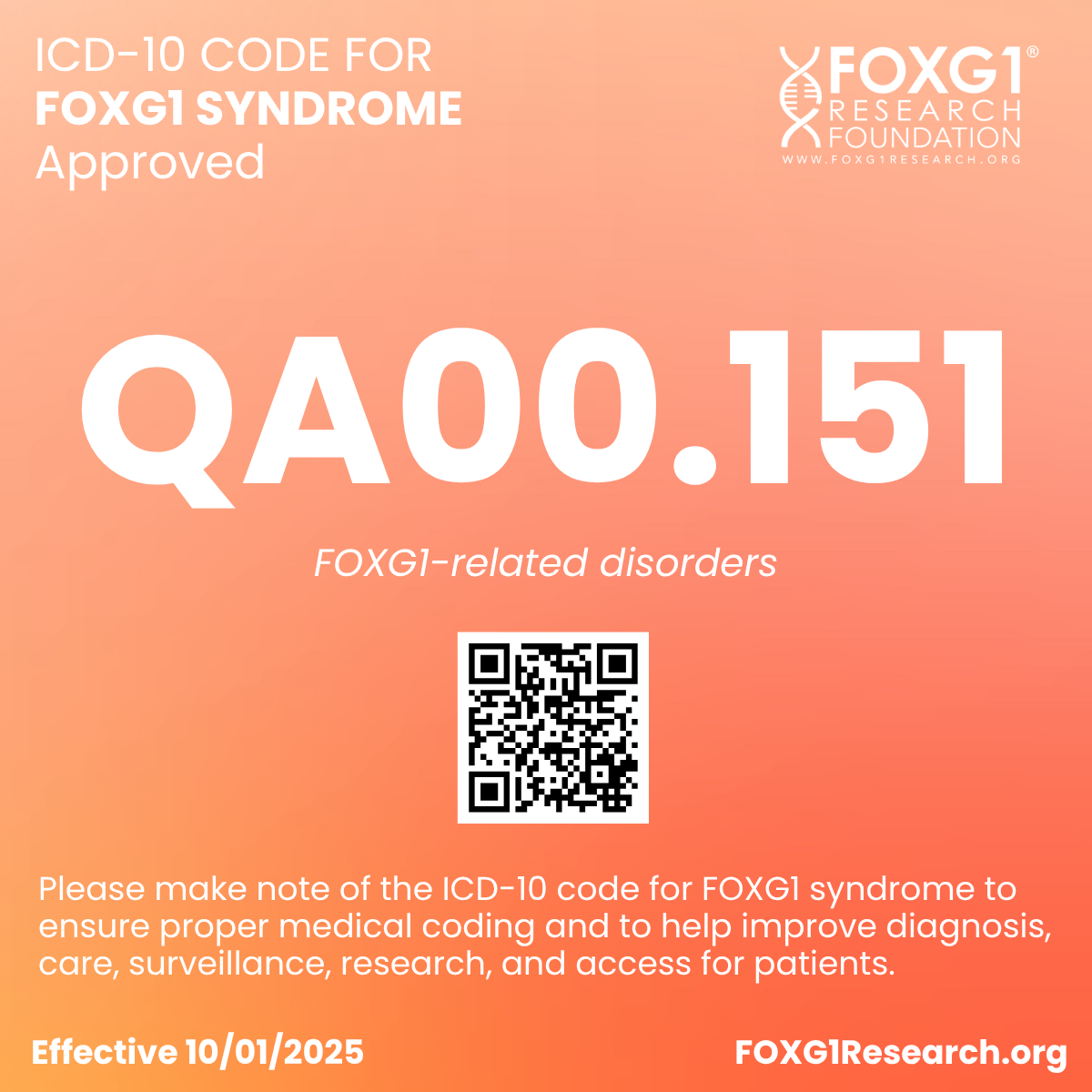
We are thrilled to announce an incredible step forward for our community: the Centers for Disease Control and Prevention (CDC) has granted FOXG1 syndrome its own ICD-10-CM diagnosis code — QA00.151 — effective October 1, 2025.
This milestone has been years in the making. After persistent effort to secure a presentation date, our Director of Clinical Data, Elli Brimble, presented last September at the CDC’s ICD-10 Coordination and Maintenance Committee meeting in Washington, D.C., outlining the medical, scientific, and patient need for FOXG1 syndrome to be recognized with its own diagnostic code. Today, that work has paid off for our entire community.
This recognition marks a turning point: FOXG1 syndrome is now officially classified with its own ICD-10 code, giving our children visibility in healthcare systems and research in a way they’ve never had before.
Watch Elli’s Announcement
What is an ICD-10 code?
The International Classification of Diseases, Tenth Revision (ICD-10) is the global system used by doctors, hospitals, insurers, and researchers to code and track medical diagnoses. These codes are essential for medical records, insurance reimbursement, public health reporting, and research.
But while many well-established conditions have their own unique codes, most rare diseases do not. Instead, patients are often grouped under broader, non-specific categories or coded only by their symptoms.
That has been the case for FOXG1 syndrome — until now. Children with FOXG1 have been documented under codes for seizures, developmental delay, hypotonia, or other manifestations. Without a dedicated code, FOXG1 syndrome was essentially invisible in health data systems, making it harder to track prevalence, study outcomes, justify services, or push for research.
Now, with the creation of QA00.151, FOXG1 syndrome is officially recognized as its own diagnosis.
Why this matters for FOXG1 families
Visibility & recognition – Clinicians can now record “FOXG1 syndrome” directly in a patient’s medical record.
Insurance & services – A unique code strengthens the case for appropriate coverage of treatments, therapies, and interventions.
Research & data – Having QA00.151 allows researchers and healthcare systems to track FOXG1 patients as a group, improving our ability to measure outcomes, identify needs, and accelerate clinical studies.
Policy & advocacy – With reliable data, we can demonstrate the true impact of FOXG1 syndrome, helping us push for newborn screening, funding, and faster therapeutic development.
What parents and caregivers should do
Please share this code — QA00.151 — with your care teams. Bring it to your child’s neurologist, pediatrician, therapists, and every clinician involved in their care. Ask that it be added to all medical records and insurance claims.
The more consistently the code is applied, the more visible FOXG1 becomes — strengthening research, improving services, and helping families access the care their children deserve.
You can click this button below to download and print your own FOXG1 ICD-10 code card to bring to appointments.
You can also save the image to your photo’s favorites.
Part of a larger milestone
This October, the CDC released more than 400 new and revised ICD-10 codes to reflect advances in medicine and better capture rare and emerging diseases. FOXG1 syndrome is now among those recognized — a powerful statement about the importance of our community’s efforts and the future of rare neurodevelopmental disorders.
Gratitude
We owe this milestone to our FOXG1 Research Foundation team and to Elli Brimble’s leadership in preparing and delivering our case, and to the many families, clinicians, and advocates who contributed to this effort over the years. Thank you to our CombinedBrain rare disease partner for banding together to drive progress.
Most of all, we celebrate this moment for every FOXG1 child and family who has waited for recognition that their diagnosis is real, specific, and deserves visibility.
Rare and Recognized
QA00.151 is more than just a code. It is proof that FOXG1 syndrome is seen, counted, and prioritized. This recognition will fuel better care today and faster progress tomorrow.
Let’s share this news widely — and let’s make sure every clinician caring for a FOXG1 child starts using QA00.151.